Desk stretches: a short routine for people who sit all day
By the Relief team · Updated 27 November 2026 · Reviewed by a physiotherapist
The short answer
Short stretching and movement breaks during the work day can ease the stiffness that builds up from sitting. In trials with office workers, regular stretching reduced neck, shoulder and lower back pain, and active breaks lowered the chance of new neck pain. Do the routine below once or twice a day, and get up from your chair at least every hour.
Sitting still for hours leaves your neck, back and hips stiff, even if you sit 'well'. Your body likes to move, and most office days do not give it many chances.
Stretching at your desk is a quick way to move every part that sitting keeps still. It works best alongside a few strength exercises, which is why a full daily plan mixes both.
What the research says
In a randomized trial with 142 office workers with neck, shoulder and lower back pain, a stretching program reduced pain in all three areas compared with a control group over 6 months.[1]
In a randomized trial with office workers at high risk of neck pain, 17% of those who took regular active breaks developed new neck pain over 6 months, compared with 44% in the control group.[2]
The 8-minute routine
Everything here is done on your chair or next to your desk, in work clothes. Use a chair without wheels for the seated moves, or lock the wheels.
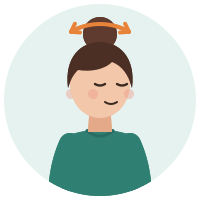
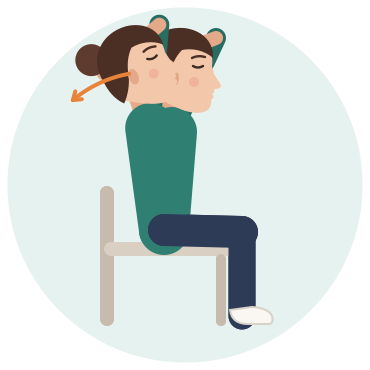
1 Neck turns
On a chair · 8 reps, hold 2 seconds each
Sit tall with your shoulders relaxed.
Turn your head slowly to look over your right shoulder.
Pause for a breath, then turn to look over your left shoulder.
Keep your chin level and your shoulders still.
Careful: Stay in a comfortable range. Stop if you feel dizzy.
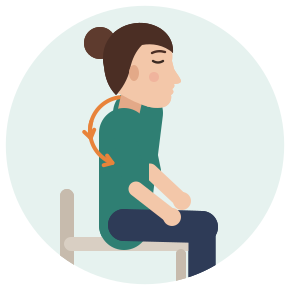
2 Shoulder rolls
On a chair · 10 reps
Sit tall with your arms relaxed.
Breathe in and lift your shoulders toward your ears.
Roll them back and squeeze your shoulder blades a little.
Breathe out and let them drop down.
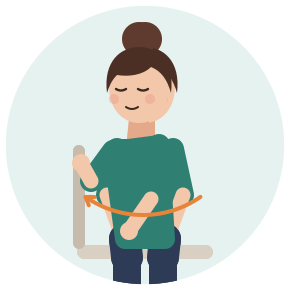
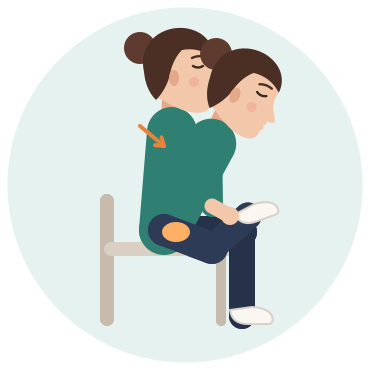
3 Seated twist
On a chair · 5 reps each side, hold 3 seconds each
Sit tall, feet flat, hips facing forward.
Turn your chest to one side and hold the chair back.
Breathe out and turn a little further.
Return to the middle, then switch sides.
Careful: Keep your hips facing forward.
4 Seated chest opener
On a chair · Hold 30 seconds
Sit near the front of your chair, feet flat.
Clasp your hands behind your back.
Draw your shoulders back and down and lift your chest. Straighten your arms as far as is comfortable.
Hold and breathe.
Careful: Keep your chin level. Do not tip your head back.
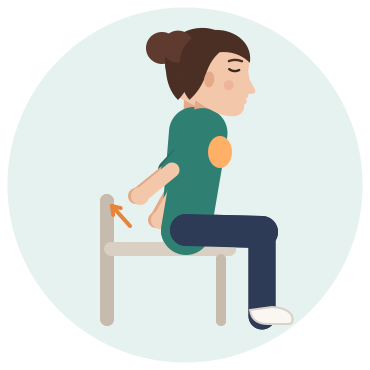
5 Chair back bend
On a chair · 8 reps
Sit tall in a chair whose backrest is below your shoulder blades.
Put your hands behind your head, elbows out.
Lean back gently over the top of the backrest.
Return to sitting tall.
Careful: The chair back should sit below your shoulder blades.
6 Seated figure 4
On a chair · Hold 30 seconds each side
Sit tall near the front of your chair.
Rest one ankle on the opposite knee.
Lean forward a little with a straight back until you feel the stretch in your hip.
Hold, then switch sides. Do not push the knee down.
Careful: Do not push the knee down.
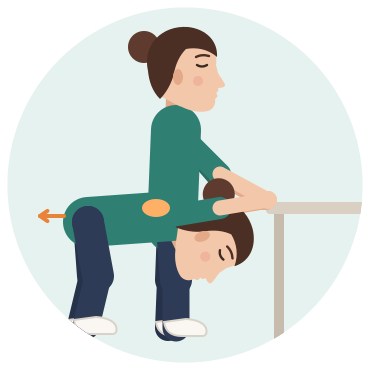
7 Desk lat stretch
Standing · 2 rounds: hold 30 seconds
Stand facing your desk and put both hands on it.
Walk your feet back until your arms are straight.
Push your hips back and let your chest drop toward the floor. Knees soft.
Hold and breathe.
Careful: Keep your knees soft.
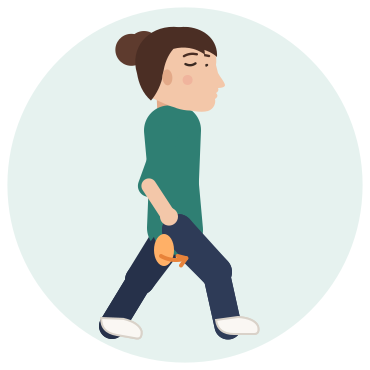
8 Standing hip flexor stretch
Standing · Hold 30 seconds each side
Stand tall and step one foot back.
Tuck your tailbone under, as if flattening your lower back.
Feel a stretch at the front of the back hip. Do not arch.
Hold and breathe, then switch sides.
Careful: Do not arch your lower back.
How to do it right
Do it every day, or at least on work days. The studies that found less pain used short sessions repeated for weeks, not one long session.
Aim for a stretch of about 4 or 5 out of 10. Strength moves can feel like effort, but they should not cause sharp pain.
Mild discomfort up to about 3 out of 10 is fine if it settles by the next morning. Skip a move if the pain is sharp or above 5 out of 10. If pain spreads down an arm or leg, or you feel numbness, tingling or dizziness, stop and see a doctor.
Breathe normally the whole time. Do not hold your breath.
Stop searching for exercises
Relief is the simple, affordable way to ease neck and back pain from sitting. Ten minutes a day, picked for your body. Relief builds your daily plan from a short quiz and guides you through every move with a timer.
Once or twice a day for the full routine is a good habit, plus getting up and moving at least every hour. Regular short breaks matter more than one long session.
Can stretching at my desk prevent back and neck pain?
It may help. In one trial, office workers who took regular active breaks were less likely to develop new neck and lower back pain. It does not guarantee you will stay pain free.
Are stretches enough on their own?
Stretching helps with stiffness, but for neck pain the research points to strengthening as the more useful type of exercise. A good daily routine includes both.
Can I do these stretches in work clothes?
Yes. None of these moves need a mat or a change of clothes.
Shariat A et al. Effects of stretching exercise training and ergonomic modifications on musculoskeletal discomforts of office workers: a randomized controlled trial. Braz J Phys Ther, 2018. Link
Waongenngarm P et al. Effects of an active break and postural shift intervention on preventing neck and low-back pain among high-risk office workers: a 3-arm cluster-randomized controlled trial. Scand J Work Environ Health, 2021. Link
This page is general information about exercise for everyday stiffness and tension. It is not medical advice and does not diagnose or treat any condition. If your pain is severe, started after an injury, or comes with numbness, tingling or weakness, see a doctor before you exercise.
 Relief