Neck pain relief: a short daily routine for desk workers
By the Relief team · Updated 27 November 2026 · Reviewed by a physiotherapist
The short answer
For everyday neck pain from desk work, the best-studied self-help is a few minutes of neck and shoulder strengthening every day, plus gentle stretches. In one trial, office workers who trained just 2 minutes a day for 10 weeks had less neck and shoulder pain than those who did not. Do the routine below daily and expect gradual change over weeks, not a one-time fix.
Neck and shoulder pain is common in people who spend most of the day at a screen. Holding the same position for hours, looking down at a laptop and working under deadline pressure all add up.
Most neck pain comes from strained muscles and joints, not from serious damage, and it often settles with time. Muscles that hold the same position all day respond well to movement and regular exercise.
What the research says
In a randomized trial with 198 office workers with frequent neck and shoulder pain, 2 minutes a day of resistance exercise with an elastic band, 5 days a week for 10 weeks, reduced pain by 1.4 points on a 0 to 10 scale compared with a control group.[1]
A 2024 review of studies in office workers with chronic neck pain found that strengthening the neck, shoulder and shoulder blade muscles reduced pain and disability. The authors rated the certainty of this evidence as low, so results vary between people.[2]
Most neck pain is caused by sprains and strains and gets better on its own. Warning signs that need a doctor are listed further down this page.[3]
In a workplace study, one 10-minute session a day worked as well as two 10-minute sessions a day. More is not always better. Regular is what matters.[4]
The 8-minute routine
Do the moves in this order. Start with gentle movement, then strength, then stretches. If you have only 2 minutes, do the side raises.
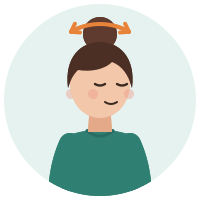
1 Neck turns
On a chair · 8 reps, hold 2 seconds each
Sit tall with your shoulders relaxed.
Turn your head slowly to look over your right shoulder.
Pause for a breath, then turn to look over your left shoulder.
Keep your chin level and your shoulders still.
Careful: Stay in a comfortable range. Stop if you feel dizzy.
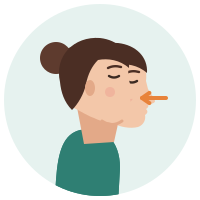
2 Chin tucks
On a chair · 8 reps, hold 5 seconds each
Sit tall and look straight ahead.
Slide your chin straight back, like making a double chin.
Keep your eyes level. Do not nod down.
Hold, then let your head glide forward to neutral.
Careful: Do not nod down. Stop if you feel dizzy.
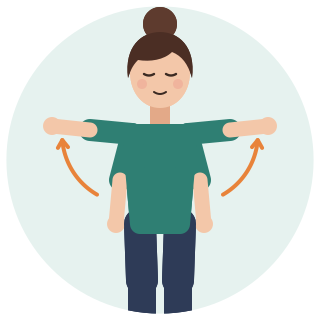
3 Side raises
Standing · 2 sets of 10 reps
Best with two 0.5 L water bottles or a light band
Stand tall, a water bottle in each hand if you have them.
Lift your arms out to the sides up to shoulder height, thumbs slightly up.
Pause at the top.
Lower slowly, taking about 3 seconds.
Careful: Stay below shoulder height if anything pinches. Stop if pain runs down your arm.
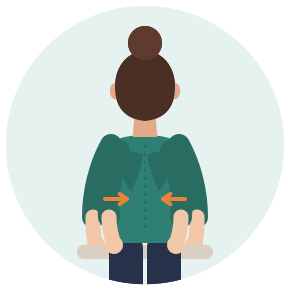
4 Shoulder blade squeeze
On a chair · 2 sets of 8 reps, hold 3 seconds each
Sit tall with your arms relaxed by your sides.
Pull your shoulder blades back and down, as if pinching a pencil between them.
Keep your shoulders away from your ears.
Hold, then relax.
Careful: Keep your shoulders away from your ears.
5 Upper trap stretch
On a chair · Hold 30 seconds each side
Sit tall and hold the side of the chair seat with your right hand.
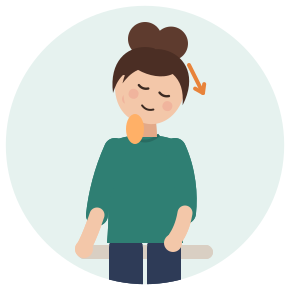
Tilt your left ear toward your left shoulder.
Stop at a gentle stretch on the right side of your neck. No pulling.
Hold and breathe, then switch sides.
Careful: No bouncing and no pulling your head with your hand.
6 Neck diagonal stretch
On a chair · Hold 30 seconds each side
Sit tall and hold the side of the chair seat with your right hand.
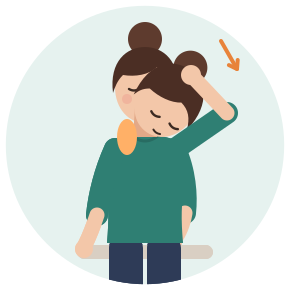
Turn your head to the left and look down, as if pointing your nose at your left hip.
Rest your left hand on the back of your head and let its weight add a gentle stretch. No pulling.
Feel it from the back of your neck to the top of your right shoulder blade. Switch sides.
Careful: Gentle stretch only. Stop if your arm tingles.
How to do it right
Do it every day, or at least on work days. The studies that found less pain used short sessions repeated for weeks, not one long session.
Aim for a stretch of about 4 or 5 out of 10. Strength moves can feel like effort, but they should not cause sharp pain.
Mild discomfort up to about 3 out of 10 is fine if it settles by the next morning. Skip a move if the pain is sharp or above 5 out of 10. If pain spreads down an arm or leg, or you feel numbness, tingling or dizziness, stop and see a doctor.
Breathe normally the whole time. Do not hold your breath.
Stop searching for exercises
Relief is the simple, affordable way to ease neck and back pain from sitting. Ten minutes a day, picked for your body. Relief builds your daily plan from a short quiz and guides you through every move with a timer.
You may feel looser right after a session. Lasting change takes longer: the trials that found less pain ran for about 10 weeks of daily or near-daily exercise.
Is it better to stretch or strengthen a sore neck?
Do both, but do not skip the strength part. Research in office workers points to strengthening the neck and shoulder muscles as the most useful type of exercise. Stretches feel good and help you move, so the routine ends with them.
Can I do these exercises at my desk?
Yes. All moves except side raises are done sitting. For side raises, stand up next to your desk and use two water bottles.
Should I keep exercising if my neck hurts?
Mild discomfort is fine. Stop a move if it causes sharp pain, pain that spreads into your arm, tingling or dizziness. NHS advice is to keep your neck moving rather than resting it completely.
Do I need a neck collar or special pillow?
NHS advice is not to wear a neck collar for everyday neck pain. A low, firm pillow may help some people.
Andersen LL et al. Effectiveness of small daily amounts of progressive resistance training for frequent neck/shoulder pain: randomised controlled trial. Pain, 2011. Link
Jones LB, Jadhakhan F, Falla D. The influence of exercise on pain, disability and quality of life in office workers with chronic neck pain: a systematic review and meta-analysis. Applied Ergonomics, 2024. Link
Saeterbakken AH et al. Dose-response of resistance training for neck- and shoulder pain relief: a workplace intervention study. BMC Sports Sci Med Rehabil, 2020. Link
This page is general information about exercise for everyday stiffness and tension. It is not medical advice and does not diagnose or treat any condition. If your pain is severe, started after an injury, or comes with numbness, tingling or weakness, see a doctor before you exercise.
 Relief