Neck hump and forward head posture: exercises and what they can change
By the Relief team · Updated 27 November 2026 · Reviewed by a physiotherapist
The short answer
Exercises that strengthen your upper back and the front of your neck and open your chest can improve forward head posture: a review of 7 trials found that exercise changed head position measurably. A neck hump made mostly of soft tissue may not go away with exercise alone, and a hump that is new or growing should be checked by a doctor. Daily practice over weeks gives the best chance of change.
'Tech neck' and 'forward head posture' describe the head sitting in front of the shoulders, which is common after years of looking at screens. A 'neck hump' is a bump where the neck meets the upper back. It can come from rounding of the upper spine, from a pad of soft tissue, or from a mix of both.
Posture is not the whole story behind neck pain. People with neck pain do tend to have more forward head posture, but research has not shown that posture alone causes pain. The good news is that the same exercises that train posture also strengthen the muscles that often ache.
What the research says
A review of 7 randomized trials with 627 people found strong evidence that exercise can improve the head-and-neck angle used to measure forward head posture, and moderate evidence that it may reduce pain. The authors noted that the link between posture and pain is not yet clear.[1]
A hump caused by rounding of the upper spine (kyphosis) is different from one caused mainly by fatty tissue. They have different causes, and a doctor can tell them apart.[2]
The 7-minute routine
Strength moves first, stretches last. Wall angels need a free wall and the chest stretch needs a doorway; the other moves are done on a chair.
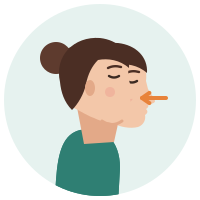
1 Chin tucks
On a chair · 8 reps, hold 5 seconds each
Sit tall and look straight ahead.
Slide your chin straight back, like making a double chin.
Keep your eyes level. Do not nod down.
Hold, then let your head glide forward to neutral.
Careful: Do not nod down. Stop if you feel dizzy.
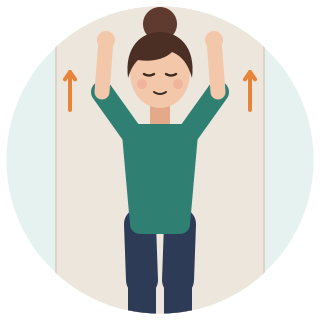
2 Wall angels
At a wall · 2 sets of 6 reps
Stand with your back against a wall, feet a small step forward.
Press your head, upper back and arms against the wall, elbows bent like goalposts.
Slide your arms up only as far as they stay on the wall.
Slide them back down slowly.
Careful: Small range is fine. Never force it.
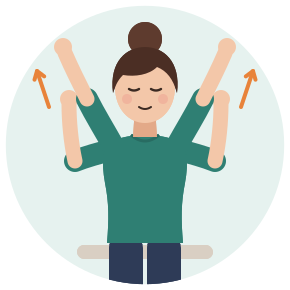
3 Seated W to Y
On a chair · 2 sets of 8 reps
Sit tall. Raise your arms into a W: elbows bent, hands at head height.
Slide your arms up into a Y above your head.
Keep your ribs down and your lower back still.
Slowly lower back to the W.
Careful: Do not arch your lower back.
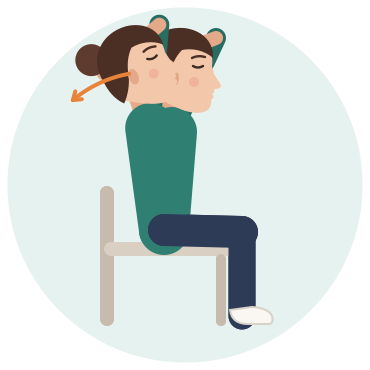
4 Chair back bend
On a chair · 8 reps
Sit tall in a chair whose backrest is below your shoulder blades.
Put your hands behind your head, elbows out.
Lean back gently over the top of the backrest.
Return to sitting tall.
Careful: The chair back should sit below your shoulder blades.
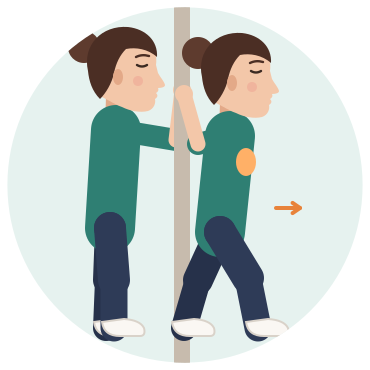
5 Doorway chest stretch
Standing · 2 rounds: hold 30 seconds
Stand in a doorway.
Place your forearms on the door frame at shoulder height.
Step one foot through until you feel your chest open.
Hold and breathe. Stop if your arms tingle.
Careful: Stop if your arms tingle.
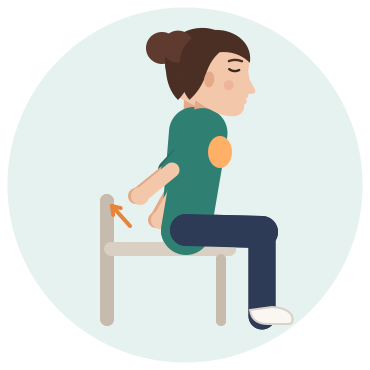
6 Seated chest opener
On a chair · Hold 30 seconds
Sit near the front of your chair, feet flat.
Clasp your hands behind your back.
Draw your shoulders back and down and lift your chest. Straighten your arms as far as is comfortable.
Hold and breathe.
Careful: Keep your chin level. Do not tip your head back.
How to do it right
Do it every day, or at least on work days. The studies that found less pain used short sessions repeated for weeks, not one long session.
Aim for a stretch of about 4 or 5 out of 10. Strength moves can feel like effort, but they should not cause sharp pain.
Mild discomfort up to about 3 out of 10 is fine if it settles by the next morning. Skip a move if the pain is sharp or above 5 out of 10. If pain spreads down an arm or leg, or you feel numbness, tingling or dizziness, stop and see a doctor.
Breathe normally the whole time. Do not hold your breath.
Stop searching for exercises
Relief is the simple, affordable way to ease neck and back pain from sitting. Ten minutes a day, picked for your body. Relief builds your daily plan from a short quiz and guides you through every move with a timer.
It depends on what the hump is. If it is mostly posture, exercise can improve how you hold your head and upper back. If it is mostly soft tissue, exercise may not make it disappear. A doctor can check which it is.
How long does it take to improve forward head posture?
Expect weeks to months, not days. A review of 10 trials found that exercise programs lasting at least 8 weeks may give larger improvements. Doing a few minutes every day is more useful than a long session once a week.
Do posture correctors work?
A brace holds you in position while you wear it, but it does not train your muscles. Exercise is the option with research behind it for changing head posture.
Does bad posture cause neck pain?
Not on its own, as far as research can tell. People with neck pain do tend to have more forward head posture, but it is not clear which comes first. Strength and regular movement help either way.
What is tech neck?
A popular name for neck strain and forward head posture from looking down at phones and laptops for long periods.
Sheikhhoseini R et al. Effectiveness of therapeutic exercise on forward head posture: a systematic review and meta-analysis. J Manipulative Physiol Ther, 2018. Link
Houston Methodist. How to get rid of a neck hump, 2024. Link
Cleveland Clinic. Dowager's hump: what it is and how to get rid of it. Link
Xing Y et al. Therapeutic exercise for forward head posture in neck pain patients: a systematic review and meta-analysis. Dove Medical Press. Link
This page is general information about exercise for everyday stiffness and tension. It is not medical advice and does not diagnose or treat any condition. If your pain is severe, started after an injury, or comes with numbness, tingling or weakness, see a doctor before you exercise.
 Relief