By the Relief team · Updated 27 November 2026 · Reviewed by a physiotherapist
The short answer
Hours of sitting keep the hip flexors, the muscles at the front of the hip, in a shortened position, and many people feel tight hips and a stiff lower back as a result. A standing hip flexor stretch held for about 30 seconds per side, done daily together with glute strength exercises, is a simple way to restore movement. Small studies suggest hip stretching can help lower back pain, but the evidence is limited.
When you sit, your hips are bent. After a long day the muscles at the front of the hip can feel tight when you stand up, and some people feel it in the lower back.
Stretching is only half of it. The glutes, the muscles that straighten the hip, do little while you sit. Strengthening them alongside the stretch is the more complete fix.
What the research says
In a randomized trial in people with non-specific lower back pain, both a core-plus-hip-stretching programme and a core-plus-hip-strengthening programme improved pain and disability more than a sham programme.[1]
In a small study of people with lower back pain and limited hip extension, 8 weeks of static stretching improved hip range of motion, pain and disability. It had no control group, so it shows a change, not proof of cause.[2]
Exercise in general reduces long-lasting lower back pain, with moderate certainty of evidence.[3]
The 8-minute routine
Start with seated pelvic tilts to warm up, then the standing stretch. The glute bridge and the kneeling stretch need a mat; if you cannot get down to the floor, skip them and do the standing leg back instead.
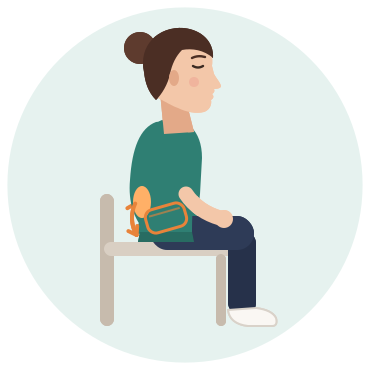
1 Seated pelvic tilts
On a chair · 10 reps
Sit near the front of your chair, feet flat.
Roll your pelvis forward so your lower back arches a little.
Roll it back so your lower back rounds a little.
Keep the movement small and smooth.
Careful: Stay in a pain-free range.
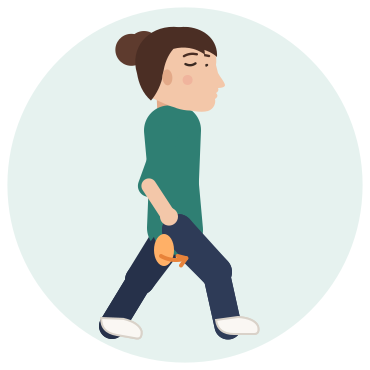
2 Standing hip flexor stretch
Standing · Hold 30 seconds each side
Stand tall and step one foot back.
Tuck your tailbone under, as if flattening your lower back.
Feel a stretch at the front of the back hip. Do not arch.
Hold and breathe, then switch sides.
Careful: Do not arch your lower back.
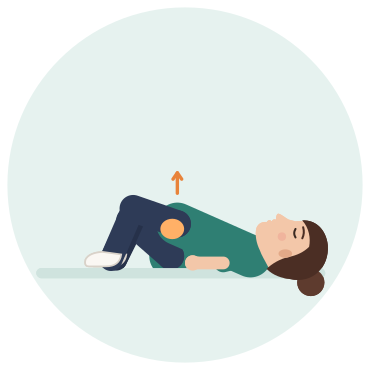
3 Glute bridge
On the floor · 2 sets of 8 reps, hold 3 seconds each
Lie on your back on a mat, knees bent, feet flat.
Push through your heels and lift your hips.
Stop when your shoulders, hips and knees make a line. Squeeze your glutes.
Lower slowly.
Careful: Lift with your glutes, not your lower back.
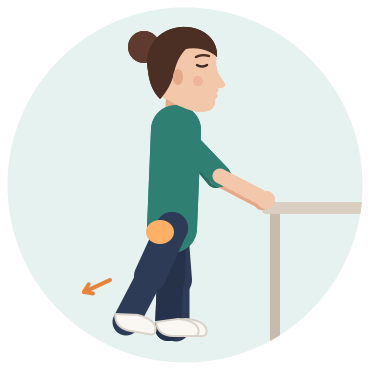
4 Standing leg back
Standing · 10 reps each side
Stand facing your desk and hold it lightly.
Move one straight leg back a little.
Squeeze your glute. Do not arch your lower back.
Bring it back, then repeat. Switch legs.
Careful: Keep the movement small.
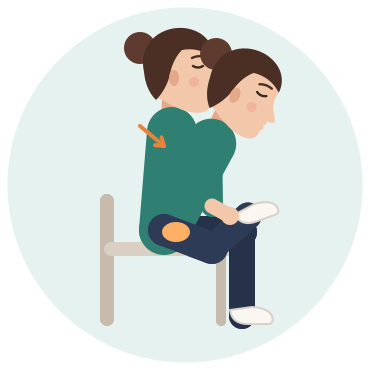
5 Seated figure 4
On a chair · Hold 30 seconds each side
Sit tall near the front of your chair.
Rest one ankle on the opposite knee.
Lean forward a little with a straight back until you feel the stretch in your hip.
Hold, then switch sides. Do not push the knee down.
Careful: Do not push the knee down.
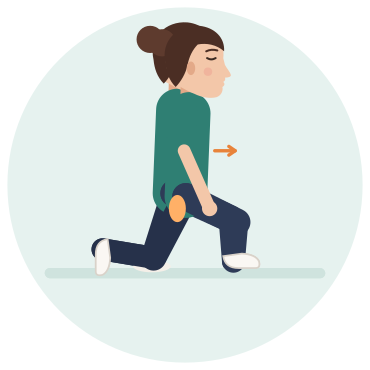
6 Kneeling hip flexor stretch
On the floor · Hold 30 seconds each side
Kneel on one knee on a mat, with a cushion under it. Front foot flat.
Tuck your tailbone under.
Shift your body forward slowly until you feel the front of the back hip stretch.
Hold and breathe, then switch sides.
Careful: Put a cushion under your knee.
How to do it right
Do it every day, or at least on work days. The studies that found less pain used short sessions repeated for weeks, not one long session.
Aim for a stretch of about 4 or 5 out of 10. Strength moves can feel like effort, but they should not cause sharp pain.
Mild discomfort up to about 3 out of 10 is fine if it settles by the next morning. Skip a move if the pain is sharp or above 5 out of 10. If pain spreads down an arm or leg, or you feel numbness, tingling or dizziness, stop and see a doctor.
Breathe normally the whole time. Do not hold your breath.
Stop searching for exercises
Relief is the simple, affordable way to ease neck and back pain from sitting. Ten minutes a day, picked for your body. Relief builds your daily plan from a short quiz and guides you through every move with a timer.
About 30 seconds per side is a common starting point. Aim for a gentle stretch of about 4 or 5 out of 10, not pain.
How often should I stretch my hip flexors?
Daily, or at least on work days. Short, regular sessions are easier to keep up and are what the studies used.
Can tight hip flexors cause lower back pain?
They can contribute in some people, but the link is not proven. Small studies suggest hip stretching can help lower back pain, especially together with core and glute exercises.
What is the best hip flexor stretch to do at work?
The standing hip flexor stretch: step one foot back, tuck your tailbone under and feel the stretch at the front of the back hip. No mat or change of clothes needed.
Kim B, Yim J. Core stability and hip exercises improve physical function and activity in patients with non-specific low back pain: a randomized controlled trial. Tohoku J Exp Med, 2020. Link
Hatefi M et al. The effect of static stretching exercises on hip range of motion, pain, and disability in patients with non-specific low back pain. J Exp Orthop, 2021. Link
Hayden JA et al. Exercise therapy for chronic low back pain. Cochrane Database of Systematic Reviews, 2021. Link
This page is general information about exercise for everyday stiffness and tension. It is not medical advice and does not diagnose or treat any condition. If your pain is severe, started after an injury, or comes with numbness, tingling or weakness, see a doctor before you exercise.
 Relief