Stiff neck or a crick in the neck: gentle exercises that help
By the Relief team · Updated 27 November 2026 · Reviewed by a physiotherapist
The short answer
A stiff neck, or a crick in the neck, usually comes from strained neck muscles after sleeping awkwardly or sitting at a screen for a long time. It is rarely serious and often eases within a few days. Keep your neck moving gently within a comfortable range: the short seated routine below is a good start, and regular neck exercise helps it come back less often.
A stiff neck often follows a night in an awkward position, a long day at a computer, or a heavy bag carried on one shoulder. Sometimes it appears overnight and the head feels stuck turned to one side. This is often called a wry neck.
Most stiff necks come from strained muscles, not damage. Resting the neck completely tends to keep it stiff. Gentle movement, a little at a time, is what usually helps.
What the research says
Neck pain or a stiff neck usually gets better after a few days or weeks and is rarely a sign of anything serious. A sudden wry neck (acute torticollis) can take up to a week to settle but usually lasts 24 to 48 hours.[1]
Health services advise staying active and moving the neck naturally and gently, unless the pain was caused by an injury or accident.[2]
For neck pain that keeps coming back, regular strength exercise for the neck and shoulders has the best evidence in office workers. In one trial, 2 minutes a day for 10 weeks reduced neck and shoulder pain.[3]
The 6-minute routine
Everything is done sitting. Move slowly and only as far as is comfortable: a stiff neck loosens bit by bit, not by pushing. Repeat the routine two or three times a day while the neck is stiff.
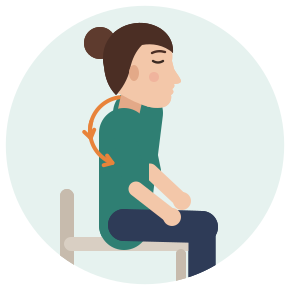
1 Shoulder rolls
On a chair · 10 reps
Sit tall with your arms relaxed.
Breathe in and lift your shoulders toward your ears.
Roll them back and squeeze your shoulder blades a little.
Breathe out and let them drop down.
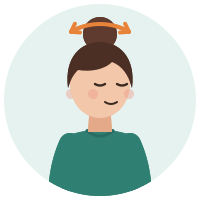
2 Neck turns
On a chair · 8 reps, hold 2 seconds each
Sit tall with your shoulders relaxed.
Turn your head slowly to look over your right shoulder.
Pause for a breath, then turn to look over your left shoulder.
Keep your chin level and your shoulders still.
Careful: Stay in a comfortable range. Stop if you feel dizzy.
3 Chin tucks
On a chair · 8 reps, hold 5 seconds each
Sit tall and look straight ahead.
Slide your chin straight back, like making a double chin.
Keep your eyes level. Do not nod down.
Hold, then let your head glide forward to neutral.
Careful: Do not nod down. Stop if you feel dizzy.
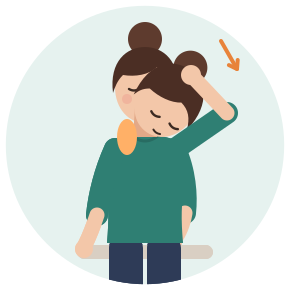
4 Neck diagonal stretch
On a chair · Hold 30 seconds each side
Sit tall and hold the side of the chair seat with your right hand.
Turn your head to the left and look down, as if pointing your nose at your left hip.
Rest your left hand on the back of your head and let its weight add a gentle stretch. No pulling.
Feel it from the back of your neck to the top of your right shoulder blade. Switch sides.
Careful: Gentle stretch only. Stop if your arm tingles.
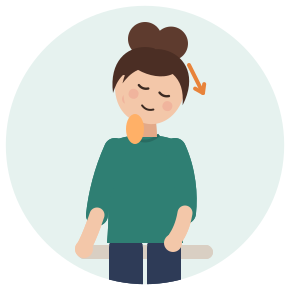
5 Upper trap stretch
On a chair · Hold 30 seconds each side
Sit tall and hold the side of the chair seat with your right hand.
Tilt your left ear toward your left shoulder.
Stop at a gentle stretch on the right side of your neck. No pulling.
Hold and breathe, then switch sides.
Careful: No bouncing and no pulling your head with your hand.
6 Slow breathing
On a chair · Hold 60 seconds
Sit comfortably and let your shoulders drop.
Breathe in through your nose for 4 seconds.
Breathe out slowly for 6 seconds.
Repeat. Let your shoulders get heavier with each breath out.
How to do it right
Do it every day, or at least on work days. The studies that found less pain used short sessions repeated for weeks, not one long session.
Aim for a stretch of about 4 or 5 out of 10. Strength moves can feel like effort, but they should not cause sharp pain.
Mild discomfort up to about 3 out of 10 is fine if it settles by the next morning. Skip a move if the pain is sharp or above 5 out of 10. If pain spreads down an arm or leg, or you feel numbness, tingling or dizziness, stop and see a doctor.
Breathe normally the whole time. Do not hold your breath.
Stop searching for exercises
Relief is the simple, affordable way to ease neck and back pain from sitting. Ten minutes a day, picked for your body. Relief builds your daily plan from a short quiz and guides you through every move with a timer.
Most stiff necks get better within a few days to a couple of weeks. A sudden wry neck usually settles in 24 to 48 hours and can take up to a week.
Should I rest a stiff neck?
Not completely. Gentle movement within a comfortable range usually helps more than keeping the neck still. Avoid anything that makes the pain clearly worse.
Is heat or ice better for a stiff neck?
Either can help. NHS advice is a wrapped hot water bottle for about 20 minutes, 2 to 3 times a day, or a wrapped bag of frozen peas for about 5 minutes, 3 times a day.
How can I stop getting a stiff neck?
Break up long stretches at the screen, use a low, firm pillow and build neck and shoulder strength with a few minutes of exercise most days.
When is a stiff neck serious?
A stiff neck with fever and a headache, after an injury, or with numbness, weakness or dizziness needs a doctor straight away.
nidirect (NHS-based). Neck pain and stiff neck. Link
healthdirect Australia. Neck pain treatments. Link
Andersen LL et al. Effectiveness of small daily amounts of progressive resistance training for frequent neck/shoulder pain: randomised controlled trial. Pain, 2011. Link
Mayo Clinic. Neck pain: when to see a doctor. Link
This page is general information about exercise for everyday stiffness and tension. It is not medical advice and does not diagnose or treat any condition. If your pain is severe, started after an injury, or comes with numbness, tingling or weakness, see a doctor before you exercise.
 Relief