Upper back and trapezius pain from desk work: exercises that help
By the Relief team · Updated 27 November 2026 · Reviewed by a physiotherapist
The short answer
Upper back and trapezius pain in desk workers is often muscle pain from holding the shoulders and arms still for hours. Strength exercise for the shoulder and upper back muscles has good evidence: in one trial, women with trapezius muscle pain who did specific strength training for 10 weeks had much less pain than those who did general fitness. Start with the short daily routine below.
The trapezius runs from the back of the head over the top of the shoulders and down between the shoulder blades. When you type and look at a screen for hours, it holds your shoulders and arms in place and rarely gets a break.
Most upper back pain is mechanical: strained muscles and stiff joints that ease with movement. Pain in the upper back is less common than neck or lower back pain, and it is a little more likely to have another cause, so the warning signs below matter.
What the research says
In a randomized trial with 48 employed women with chronic trapezius muscle pain, 10 weeks of specific strength training for the neck and shoulder muscles cut their worst pain by about 79%. General fitness training on a bike gave only a small, short-lived drop.[1]
A review of studies in office workers found that strengthening the neck, shoulder and shoulder blade muscles reduced pain, with low certainty of evidence.[2]
Most upper (thoracic) back pain comes from muscle strain, posture or overuse and improves within a few weeks. Because it is more likely than neck or lower back pain to have a serious cause, severe, constant or worsening pain should be checked.[3]
The 7-minute routine
Movement first, then strength, then a stretch for the area between the shoulder blades. Side raises are done standing next to your desk with two water bottles; the rest is on a chair.
1 Shoulder rolls
On a chair · 10 reps
Sit tall with your arms relaxed.
Breathe in and lift your shoulders toward your ears.
Roll them back and squeeze your shoulder blades a little.
Breathe out and let them drop down.
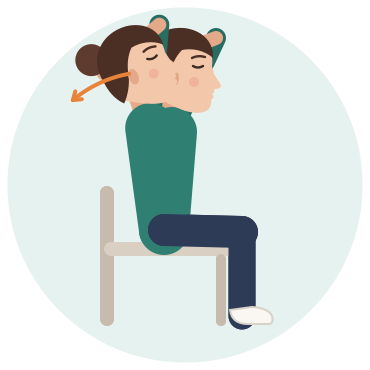
2 Chair back bend
On a chair · 8 reps
Sit tall in a chair whose backrest is below your shoulder blades.
Put your hands behind your head, elbows out.
Lean back gently over the top of the backrest.
Return to sitting tall.
Careful: The chair back should sit below your shoulder blades.
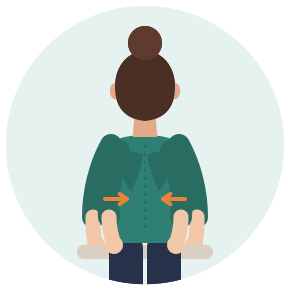
3 Shoulder blade squeeze
On a chair · 2 sets of 8 reps, hold 3 seconds each
Sit tall with your arms relaxed by your sides.
Pull your shoulder blades back and down, as if pinching a pencil between them.
Keep your shoulders away from your ears.
Hold, then relax.
Careful: Keep your shoulders away from your ears.
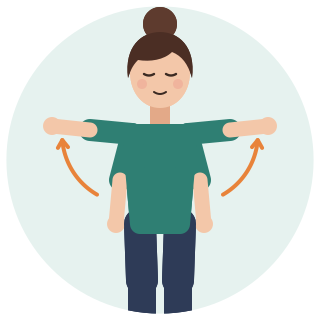
4 Side raises
Standing · 2 sets of 10 reps
Best with two 0.5 L water bottles or a light band
Stand tall, a water bottle in each hand if you have them.
Lift your arms out to the sides up to shoulder height, thumbs slightly up.
Pause at the top.
Lower slowly, taking about 3 seconds.
Careful: Stay below shoulder height if anything pinches. Stop if pain runs down your arm.
5 Seated W to Y
On a chair · 2 sets of 8 reps
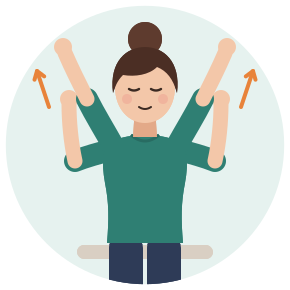
Sit tall. Raise your arms into a W: elbows bent, hands at head height.
Slide your arms up into a Y above your head.
Keep your ribs down and your lower back still.
Slowly lower back to the W.
Careful: Do not arch your lower back.
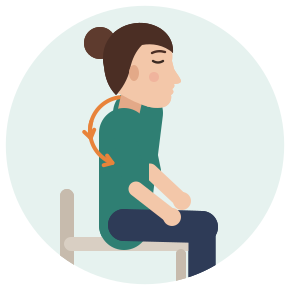
6 Upper back stretch
On a chair · Hold 30 seconds
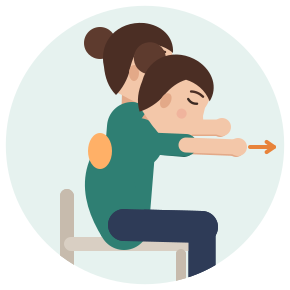
Sit tall and clasp your hands in front of you at shoulder height.
Push your hands forward and round your upper back, like hugging a big ball.
Let your chin drop gently toward your chest.
Breathe into the space between your shoulder blades.
Careful: Round your upper back, not your lower back. Keep your hips still.
How to do it right
Do it every day, or at least on work days. The studies that found less pain used short sessions repeated for weeks, not one long session.
Aim for a stretch of about 4 or 5 out of 10. Strength moves can feel like effort, but they should not cause sharp pain.
Mild discomfort up to about 3 out of 10 is fine if it settles by the next morning. Skip a move if the pain is sharp or above 5 out of 10. If pain spreads down an arm or leg, or you feel numbness, tingling or dizziness, stop and see a doctor.
Breathe normally the whole time. Do not hold your breath.
Stop searching for exercises
Relief is the simple, affordable way to ease neck and back pain from sitting. Ten minutes a day, picked for your body. Relief builds your daily plan from a short quiz and guides you through every move with a timer.
The trapezius holds your shoulders and arms steady while you type and look at a screen, often for hours without a break. Tired, overworked muscles can ache.
Is stretching or strengthening better for trapezius pain?
Strengthening has the stronger evidence. In a trial with office workers, specific strength training reduced trapezius pain far more than general exercise. Stretches help with stiffness, so the routine includes both.
Is pain between the shoulder blades serious?
Usually not, but it is worth checking with a doctor if it is severe, constant, worse at night, or comes with chest pain, shortness of breath or feeling unwell.
How often should I do upper back exercises?
Most days. The studies that found less pain used short, regular sessions over about 10 weeks.
Andersen LL et al. Effect of two contrasting types of physical exercise on chronic neck muscle pain. Arthritis Rheum, 2008. Link
Jones LB, Jadhakhan F, Falla D. The influence of exercise on pain, disability and quality of life in office workers with chronic neck pain: a systematic review and meta-analysis. Applied Ergonomics, 2024. Link
This page is general information about exercise for everyday stiffness and tension. It is not medical advice and does not diagnose or treat any condition. If your pain is severe, started after an injury, or comes with numbness, tingling or weakness, see a doctor before you exercise.
 Relief